
Disclosure: This page contains affiliate links. If you buy through them we may earn a commission, at no extra cost to you.
The short answer
Most teams need a data pipeline before an attribution platform. Get every channel’s spend next to conversions first, then pay for attribution once the data is clean.
On this page
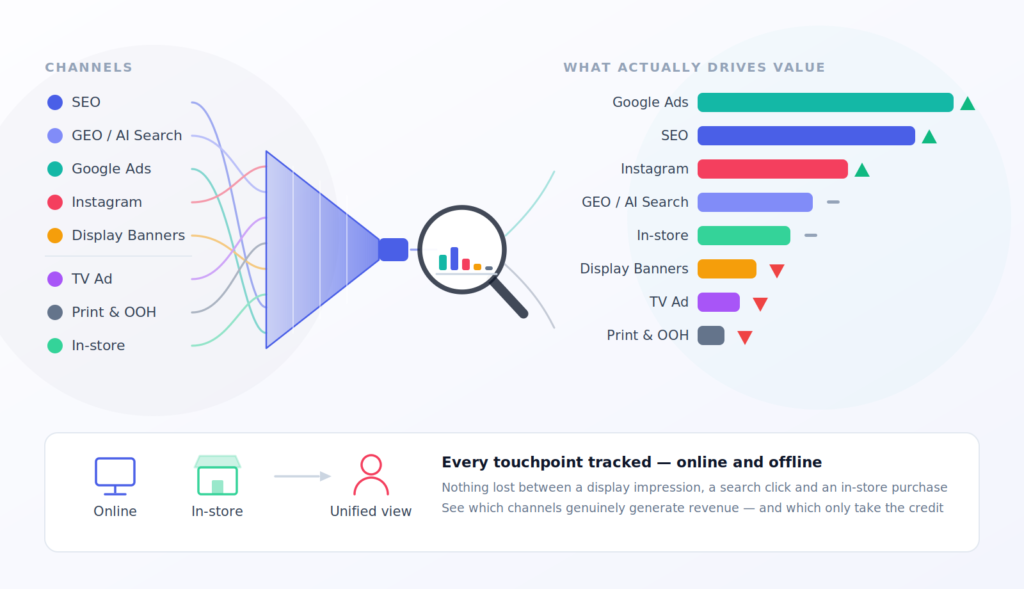
Most marketing teams hit the same wall. GA4 tells you what happened on your website. It does not tell you what your Meta spend actually contributed, whether that TikTok campaign drove incremental revenue or just took credit for buyers you already had, or what your blended cost per acquisition looks like across eight channels at once.
Upgrading to Google Analytics 360 does not fix that. It raises limits — more events, less sampling, longer retention — but the gaps are structural, not quota-based. This guide covers the tools that sit on top of GA4, what each layer does, and roughly what you should expect to pay at different scales.
Where GA4 and GA360 Actually Stop
Worth being precise about this, because the answer determines whether you need any of these tools at all.
What free GA4 gives you
- 500 distinct events per property, 50 custom dimensions and 50 custom metrics
- BigQuery export capped at 1 million events per day on the daily batch export — streaming has no daily cap but needs a billing-enabled Google Cloud project
- Explorations begin sampling somewhere around 10 million events, though Google does not publish an official threshold
- Event-level retention capped at 14 months in the interface
- No SLA, and no subproperties or roll-up properties
What GA360 adds
- BigQuery export raised to roughly 20 billion events per day
- Unsampled exploration results on request
- Data retention extended to 50 months
- SLAs covering collection, processing and reporting
- Subproperties and roll-up properties
- A six-figure annual licence, sold through Google Marketing Platform orders or a Google Sales Partner
What neither one does
This is the part that matters. None of the following is a limit you can buy your way out of by upgrading to 360 — they sit outside what Google Analytics is designed to do:
- Blend ad cost data from Meta, TikTok, LinkedIn or any non-Google platform alongside your conversions
- Run incrementality tests to establish whether a channel caused conversions or merely witnessed them
- Build media mix models that account for offline and brand spend
- Join CRM, subscription or offline revenue data to marketing touchpoints cleanly
One change matters more than any other here. Under Universal Analytics, BigQuery export required a paid GA360 contract. GA4 gives every standard property BigQuery export at no additional cost. The raw event data most teams could never previously touch is now sitting there for free — and the tools below exist to do something useful with it.
Quick Summary: Attribution and Analytics Tools
Four enterprise platforms and three accessible options, by use case.
Scroll sideways to compare all columns →
| Tool | Best For | Starting Price |
|---|---|---|
| OWOX BI | Pipelines + attribution on BigQuery | Free / from $65/mo |
| Rockerbox | Enterprise MTA, MMM & incrementality | Quote only |
| Funnel.io | Enterprise data normalization | From $300/mo (annual) |
| Improvado | Very large enterprise, 500+ connectors | Free (limited) / $100/mo / custom |
| Windsor.ai | Best value attribution for SMBs | Free / $19/mo (annual) |
| Coupler.io | Spreadsheet reporting | Free / $24/mo (annual) |
| Porter Metrics | Looker Studio reporting | $12.50 per account/mo (annual) |
Prices checked on each vendor’s own pricing page in September 2026; tools that don’t publish pricing are marked quote-only. One warning about your own research here: almost every comparison article in this space is published by a vendor about its competitors, which is why connector counts for the same product range from 150 to 350 depending who is counting.
Enterprise Tools
These four are built for organisations with real data volume and, in most cases, someone internally who can own the implementation. Several now publish entry prices, but the full platforms are priced for scale.
1. OWOX BI — Pipelines and Attribution on BigQuery
OWOX sits in an unusual position: it handles both layers. It pulls cost, session and CRM data from across your stack into BigQuery, and it builds attribution models on top of that data rather than handing off to a separate platform. For teams already committed to BigQuery as their marketing warehouse, that removes a vendor from the stack.
It handles genuinely large data volumes, which is the reason it shows up in enterprise stacks rather than just mid-market ones. The attribution modelling is where it differentiates from pure pipeline tools like Funnel — you are not just moving rows, you are deciding what those rows mean.
Worth knowing separately: OWOX Data Marts is a free, open-source, self-service analytics layer with no licence limits or vendor lock-in. You define metrics once in SQL and reuse them across BI tools. That is a genuinely useful entry point if you want to test the approach before committing to the paid platform.
Best for: teams running marketing analytics on BigQuery who want pipelines and attribution from one vendor.
Skip if: you have no warehouse and no appetite for SQL — the value here assumes both.
- Unified pipelines from ad platforms, GA4 and CRM into BigQuery
- Attribution modelling built on your own warehouse data
- Handles enterprise-scale data volumes
- OWOX Data Marts available free and open-source
- Assumes SQL capability on the team
Pricing: A free tier with 30 one-time credits and an open-source edition on GitHub; paid plans start at $65/month (50 credits a month), with Enterprise custom.
2. Rockerbox — Enterprise Attribution, MMM and Incrementality
Rockerbox is the most complete measurement platform on this list, combining multi-touch attribution, media mix modelling and incrementality testing in one place. Most vendors do one of those three well. Doing all three matters because they answer different questions — MTA tells you which touchpoints appeared on converting journeys, MMM estimates channel contribution including offline and brand, and incrementality testing establishes causation rather than correlation.
Be clear-eyed about who it is for. Rockerbox is built for brands advertising across many channels with large budgets, and it doesn’t publish pricing. It also expects an internal analytics resource — this is not a tool you buy and leave running.
Best for: large advertisers running many channels who need to defend budget allocation with more than last-click.
Skip if: you advertise on a handful of channels with a modest budget — it is built for scale.
- MTA, MMM and incrementality testing in a single platform
- Integrates with Snowflake, BigQuery and Redshift
- Deduplicates conversions across paid, organic and offline
- Priced on marketing spend under management and channel count
- Assumes an internal data analytics resource
Pricing: Quote-based; Rockerbox doesn’t publish prices.
3. Funnel.io — Enterprise Data Normalization
Funnel’s speciality is the unglamorous part: taking data from hundreds of sources with inconsistent schemas, naming conventions and currencies, and making it consistent enough to actually query. Its architecture is warehouse-first — data flows through Funnel’s managed warehouse before reaching Looker Studio, Sheets, or your own BigQuery or Snowflake instance.
Its Business plan lists 579 connectors (600+ on Enterprise). Its core job is moving and normalising data; measurement (Funnel Measure) is available on the Business and Enterprise plans, priced separately by ad spend.
Best for: teams whose main pain is messy, inconsistent data across many platforms.
Skip if: you want measurement included in the base price — it is priced separately.
- Around 590 connectors, tiered across plans
- Warehouse-first architecture with managed storage included
- Strong data normalisation and governance
- Annual contracts, enterprise SLAs and SOC2
- Measurement (Funnel Measure) available on Business and Enterprise
Pricing: Starter $300/month and Business $600/month, both billed annually; Enterprise is custom.
4. Improvado — Very Large Enterprise
Improvado is the heaviest option here, with 500+ connectors, a marketing-specific data model, automated mapping and normalisation, and a dedicated customer success manager included. Packages bundle customisation credits and professional services, which tells you what kind of buyer it is built for — organisations that want the vendor to do the implementation rather than hand over documentation.
Improvado now publishes a limited free tier and an MCP Only plan at $100 a month — its connections and data modelling inside your AI tools, capped at 2 million rows a year — but the full platform (Advanced and Enterprise) is custom-quoted. If you are a large agency managing many client accounts or an enterprise with sprawling data sources, that cost is defensible. Otherwise Funnel or OWOX will do the same job for less.
Best for: large enterprises and agencies with many clients, big ad budgets and no appetite for DIY.
Skip if: you would blink at a five-figure annual commitment — this is not the right tier.
- 500+ connectors with a marketing-specific data model
- Automated mapping, normalisation and advanced transformations
- Customisation credits and professional services included
- Dedicated CSM and enterprise support
- No public starting price without contacting sales
Pricing: Free (limited) and MCP Only at $100/month are published; Advanced and Enterprise are custom.
Small Business Picks: Beyond GA4 Without Enterprise Budgets
If you have outgrown GA4 but Rockerbox is a different universe, these three cover the most valuable gap for a fraction of the cost — seeing ad spend and conversions from every channel in one place, which GA4 simply will not do for non-Google platforms.
Windsor.ai — best value attribution
Windsor is the closest thing here to real attribution at a small-business price. It pulls from 325+ sources and models how touchpoints contribute to conversions, rather than just piping rows into a spreadsheet. Unusually, every connector is available on every pricing tier — most competitors reserve their better connectors for premium plans. There is a 30-day free trial, then a free plan with one data source; paid plans start at $19/month billed annually ($23 monthly).
Coupler.io — best for spreadsheet reporting
Coupler pulls from 400+ sources into Google Sheets, Excel, BigQuery or its own dashboards. Its free plan covers one data source, one destination and one account, with manual refreshes and a 100-row cap per run. Paid plans start at $24/month billed annually (Starter), with the Active tier at $99/month billed annually once you need more accounts, destinations and users. Good fit if your team already lives in spreadsheets.
Porter Metrics — best for Looker Studio
Porter is built specifically as a Looker Studio connector, with cross-channel blending handled automatically and 50+ one-click templates. Plans include unlimited users, reports and historical data, which matters if several people need access, and there is a free plan after a 14-day trial. Pricing is per connected account at $12.50 each per month billed annually ($15 monthly) — cheap for two or three sources, less so once a typical stack of GA4, Google Ads, Meta, LinkedIn and TikTok pushes you past $60/month.
A note on the pricing models: Porter charges per connected account and Supermetrics per connector, while Coupler and most others charge flat rates. Per-connector looks cheaper at first and scales unpredictably. Count your sources before choosing.
How to Choose
Work out which problem you actually have. They are not the same problem, and buying the wrong layer is expensive.
“I cannot see my Meta and TikTok spend next to my conversions.” That is a pipeline problem. Windsor.ai or Coupler.io solve it for tens of dollars a month. You do not need an enterprise platform.
“My reporting is manual and eats a day every month.” Also a pipeline problem, one tier up. Funnel.io or Porter Metrics depending on budget and whether you live in Looker Studio.
“I have the data but cannot tell which channels actually drive revenue.” Now you need attribution. OWOX if you are on BigQuery and have SQL capability; Windsor.ai for a lighter-weight model.
“I need to prove incrementality to a CFO.” This is the Rockerbox tier, and it is genuinely the only tool here that answers it. Expect enterprise pricing and an internal analyst to run it.
One thing worth doing before any of this: turn on GA4’s BigQuery export. It is free, it takes about ten minutes, and it starts accumulating raw unsampled event data immediately. Even if you buy nothing else this year, you will want that history when you do.
Frequently Asked Questions
Do I need GA360 to use these tools?
No. In fact the opposite — GA4’s free BigQuery export is what makes most of them accessible. Under Universal Analytics that export required a GA360 contract; now every standard property gets it. Upgrade to 360 for higher limits, unsampled data and SLAs, not to unlock these tools.
What is the difference between MTA, MMM and incrementality?
Multi-touch attribution assigns credit across the touchpoints on a converting journey. Media mix modelling estimates channel contribution statistically, including offline and brand spend that MTA cannot see. Incrementality testing withholds spend from a control group to measure what a channel actually caused rather than merely witnessed. They answer different questions, and serious measurement usually needs more than one.
Is OWOX or Rockerbox better?
They solve different problems, so the comparison rarely comes up in practice. OWOX handles pipelines and attribution on your own BigQuery warehouse, and suits teams with SQL capability. Rockerbox is a managed measurement platform adding MMM and incrementality on top of attribution, aimed at large advertisers. Some organisations run both.
What is the cheapest way to see blended cost per acquisition across channels?
Coupler.io’s free tier or Windsor.ai’s free tier will both get ad spend and conversion data into one view, though with meaningful limits — Coupler caps rows and requires manual refresh, Windsor’s free tier allows one source. Realistically, budget $20–30/month for something that runs automatically across your full channel mix.
Can I just use BigQuery and skip these tools entirely?
Yes, if you have engineering resource. GA4 data lands in BigQuery free, and you could write your own connectors for ad platforms and your own attribution logic in SQL. What you are buying from these vendors is maintained connectors that survive API changes, plus modelling you would otherwise build. For teams with a data engineer, DIY is genuinely viable. For most marketing teams it is not.
The Bottom Line
Most teams reading this need a pipeline, not an attribution platform. If you cannot currently see Meta, TikTok and Google spend alongside conversions in one view, start with Windsor.ai or Coupler.io, spend under $30 a month, and solve 80% of the problem this week.
Attribution modelling becomes worth paying for once the data is clean and the budget is large enough that misallocation costs real money. At that point OWOX makes sense if you are on BigQuery with SQL capability, and Rockerbox if you are spending millions across many channels and need incrementality evidence rather than correlations.
And whatever you decide, turn on the GA4 BigQuery export today. It is free, and the history it accumulates is the one thing you cannot buy retroactively.
Related comparisons
- Trending Marketing Courses in 2026 — including the server-side tagging and BigQuery training behind these tools
- Best Automation Tools for Marketing Teams — for moving data between the tools you report on
- HubSpot vs Pipedrive — the CRM your reporting will have to read from